



The best holiday table centrepiece is one low, generous bowl that can hold whatever December hands you, and still earns its place on the table in February. Not a runner of fake garland and glitter pinecones. Not an arrangement so tall that nobody can see the person across from them. One good piece, filled with clementines or pears or nothing at all, with candlelight and a few small things around it. Find the bowl first and let the rest of the table follow.
This guide covers how we would build a holiday centrepiece around a single handmade vessel, what to put in it through the season, how to light the table, and what happens to it once the decorations come down. Most of the pieces here are from Katherine Holland's newest work.
In this guide
- What makes a good holiday table centrepiece?
- Why start with one big bowl?
- What do you put in a centrepiece bowl in December?
- Do you need flowers or greenery?
- How should you light a holiday table?
- What happens to it in January?
- Frequently asked questions

What makes a good holiday table centrepiece?
Three things, in this order. It stays low enough that people can talk over it. It leaves room for the food, because the food is the actual event. And it looks intentional with very little in it, since by the second helping someone will have moved half of it to the counter.
Most centrepieces fail on the first point. Tall arrangements photograph well and dine badly. You spend the evening leaning around a branch of eucalyptus to hear your aunt. A wide, low form solves this without any effort on your part.
The second failure is quantity, and December is where it gets worst. A table crowded with ornaments, figurines and scattered sparkle reads as clutter the moment the serving dishes arrive. We would rather see one piece with presence and three or four small things nearby than a dozen things competing for the same eighteen inches of tablecloth. We made the same argument about rooms in How not to make it look precious, and it holds for a dinner table.
Why start with one big bowl?
Because a bowl does the most jobs, and the holidays are a run of different meals rather than one. It can hold clementines for a week, bread at the big dinner, salad on Boxing Day and keys by New Year's. A vase does one thing. A bowl adapts.
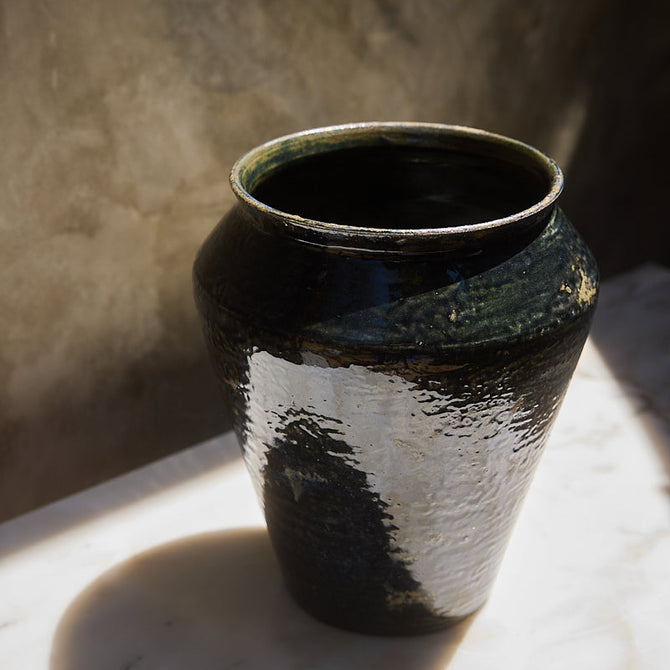
Katherine Holland's Feast Bowl is built for exactly this. Our product notes describe it as a centrepiece designed for gatherings, with a generous 15-inch surface, a rough-poured custom amber glaze outside and a layered, glossy glaze inside. It is also listed as food and oven safe, which matters more than it sounds: it means the centrepiece and the serving dish can be the same object, and a table already crowded with platters gets one thing fewer on it.

Katherine Holland / Toronto
Feast Bowl No5
A 15-inch serving bowl with an amber exterior and a glossy layered interior. Food and oven safe. Clementines all week, salad on Boxing Day.
$490 CAD
Shop now
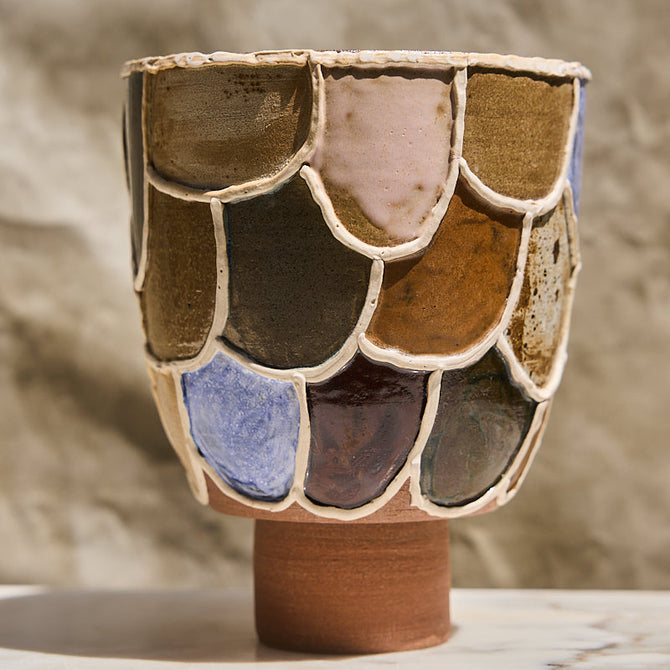
If a 15-inch bowl is more than your table can hold, the Crater Showboat is the smaller answer. It is a wide, footed form, with a glaze that moves through cream, stone and earthy brown on the outside and turns to a dark, glossy finish with crystalline patches inside, the kind that looks like ice or broken glass. In candlelight that interior does a lot of work. The foot lifts it just enough to feel deliberate without blocking anyone's view. The Crater Showboat No2 is $410 CAD.

What do you put in a centrepiece bowl in December?
Whatever is good that week, in quantity. The rule we use is one ingredient, piled generously, rather than a composed mix. A bowl of only clementines looks like a decision. A bowl of clementines, three baubles, a pinecone and some fake berries looks like a craft store.
A few that work through the season:
- Clementines, still with a few leaves if you can find them. They get eaten, which is the point.
- Pears or pomegranates, left whole. Pomegranates in particular hold their colour for weeks.
- Bread, on the day, if the bowl is food safe.
- Nothing. A glaze with enough going on can carry an empty bowl.
That last one is not a cop-out. Katherine told us in our Q&A with her this summer that she designs pieces to meet you where you are: "Don't have the time or desire to put in a floral frog, or some flowers? That's a bowl for oranges now." We would add that in the middle of December, it can also just be a bowl.

Do you need flowers or greenery?
No. But if you want some, use less than you think and keep it low.
For greenery, a few cuttings of cedar or pine laid flat along the table do more than a full garland, and they smell like the season without anyone lighting anything. Keep them clear of candle flames, and expect them to dry out within a week or so.
For flowers, a small ikebana-style bowl lets you place three or four stems with some space around them, which reads as more considered than a full bouquet and leaves the sightlines clear. A single branch of white amaryllis or a few stems of hellebore is plenty. Katherine's Plover Ikebana Bowl was made with flower arranging in mind: a warm, speckled exterior in sandy neutrals and a deep plum-brown interior. Put it at one end of the table, off-centre from the main bowl, and it keeps the big piece from looking lonely.

Katherine Holland / Toronto
Plover Ikebana Bowl
A small, low bowl made for a few carefully placed stems. Speckled sand outside, plum-brown inside.
$180 CAD
Shop now
If you want height somewhere, put it on the sideboard, not the table. A pedestal piece like the Monet Pedestal Vase No2 ($490 CAD) holds a few evergreen branches at a level where people can actually see them while they stand around with a drink. Its Monet glaze is named for its resemblance to painted lily pads: greens, turquoise, blue and touches of ochre, pooling differently with each firing.

How should you light a holiday table?
With two kinds of candle, used at different times. Scented candles belong to the hour before dinner: light them before guests arrive, then blow them out when the food comes to the table. Food should be the loudest smell in the room. On the table itself, use unscented candles with a steady flame, set low and spread out so nobody is squinting past one to see across.
For the table, Daiyo's sumac wax candles are made in Takashima, Japan, in the warosoku tradition: plant-based wax from the haze tree, built up by hand in layers around a washi paper core. They burn with a tall, steady flame and very little smoke, which is exactly what you want a foot from someone's plate. A box of four, grouped around the bowl, is enough light for a long dinner.

Daiyo / Takashima, Japan
Sumac Wax Candles, 13 cm
Four plant-wax candles with a tall, steady flame and very little smoke. The light for the table itself.
$32 CAD
Shop now
For the hour before, something that smells like the season without smelling like a gift shop. Flamingo Estate's Douglas Fir Vetiver Candle ($89 CAD) is green and woody rather than sweet. Light it in the hall or the living room, not beside the gravy.
What happens to it in January?
This is the real test, and the reason we would spend on the bowl rather than on the things that go in it. Holiday decor has a shelf life of about three weeks. In January it goes into a bin in the basement until next year.
A good bowl does not go anywhere. It moves to the kitchen island, or the entry table, or the middle of the coffee table with a stack of mail in it. In January it holds the last of the clementines. In February it holds nothing and still looks like something. The pieces in this guide are handmade and one of a kind, and none of them is shaped like a reindeer, which is most of what makes them useful the rest of the year.
So buy the bowl for the holidays. Keep it for the rest of the year.
Frequently asked questions
How tall should a holiday table centrepiece be?
Low enough that seated guests can see and talk across it. That is why we build around a wide bowl rather than a tall vase. Save anything with height for a sideboard or a side table, where people see it standing up.
Can you serve food from a ceramic centrepiece bowl?
Only if the glaze is food safe, and that varies piece by piece with handmade ceramics. The Feast Bowl No5 is listed as food and oven safe. For decorative pieces, keep food in a liner or use them for whole fruit only, and check each product page or ask us in store.
Should the centrepiece match the dishes?
No. A handmade bowl reads more clearly against plain, matching plates than against other handmade pieces. Let the centrepiece be the one thing on the table with some character, and keep the rest quiet.
What can I use instead of flowers?
Whole fruit piled in one variety, a few evergreen cuttings laid flat, or an empty bowl with a strong glaze. All of them last longer than cut flowers and none of them blocks the view.
Are scented candles okay on a dinner table?
Better not during the meal. Scent competes with the food. Burn scented candles before guests sit down, then switch to unscented ones on the table.
Shop Katherine Holland
Katherine's pieces, including the Feast Bowl, the Crater Showboat, the Plover and Monet glazes and more, are in our shop at 2090 Dundas Street West in Roncesvalles and online. Each is one of a kind, so what you see is what there is.


