



Katherine Holland is a photographer and ceramicist based in Toronto. Her work is in our shop and in the September issue of House & Home. We asked her about the space between those two practices, about Summer Bonfire ash and patchwork glaze, and about what she hopes you feel when you pick up one of her pieces for the first time. Her answers are below.
In this Q&A
- The two practices
- The work and the process
- On the handmade object
- The collection and what's next
- Frequently asked questions

Katherine Holland Ceramics at Mararamiro in Toronto.
The two practices
You built a career as a photographer before ceramics became central to your practice. When did clay enter the picture, and what did it offer that photography couldn't?
"As a photographer, I get to be social. I get to bounce off the energy of other people, pump their tires, and then go home and turn it into a memory for them. No two days are the same, and I'm incredibly grateful to be able to do it for a living. But it does require you to be your own master. You need to be self driven, and you need to stay curious and interested in building something new, and you need to stay inspired. That can be really difficult when you are as busy as I am, because sometimes it feels like the shoot is gone before it started. You shoot it, you edit it, you deliver it, they use it to launch their new thing, and just as fast as it started it's gone, living on a hard drive somewhere, and I'm onto the next one.
Ceramics are different. You are absolutely, unequivocally, forced to slow down. And that is a lesson I really struggled with and really benefited from when I started six years ago. But your reward at the end of it is something tangible. The process of turning clay from the ground into something beautiful and real is magic. I absolutely can't get enough of it. There's a freedom to it, and a staying power. And the clay calls you on your bullshit. It knows immediately if you aren't feeling it, and it will refuse to cooperate. It's like a cat."
Photography is about light hitting a surface. Ceramics is about making the surface. Do those two ways of seeing ever feel like they're in tension, or have they become a single way of working?
"The constant in all of my work throughout my life is light. I want to find the light in people, I want to see an interaction, a change, and an elevation. I love shaping it. I am drawn to classic forms with some quirk, and then I use texture to build out the light. Flat pieces do absolutely nothing for me. So either the shape itself forces your eye to interact with it, moving it around, or the glaze texture does. There should be no standing still."
Is there a compositional instinct from photography that you catch yourself applying at the wheel or the worktable?
"I think there is a timelessness I ask for in my work, across the board. I like something that gives a sense of comfort. And because of that, I try to keep balance in mind. Some shapes simply create more comfort than others. I like round edges and unpredictability. And in photography, your eye will always go to the lightest spot first, which is why I almost always build with dark clays and grow from there. I get more depth that way."
Storytelling is a word that comes up in how people describe your photography. Do you think of a ceramic piece as having a narrative?
"If nothing else, it is certainly a narrative within me. I have watched how much my work has changed over the last six years, and I never would have thought I could possibly have built all of the glazes and shapes that I have now. It's an interesting gut check, seeing what you are drawn to. If you find yourself playing it safe, you are probably feeling insecure. If the shapes are bolder and less influenced, you probably have something you need to get out. But I do really love the idea of the pieces talking to each other. They look so different, but I want them speaking the same language, if that makes sense."
The work and the process
Your collection spans a real range. How do you think about that range? Is it intentional, or does it just reflect where the work goes?
"It is definitely intentional. I think if you make something and you are looking to grow your audience or your own inspiration, you need something in the collection to be accessible. An introduction to the line that you can wrap your head and your hand around. Mugs don't necessarily sit with my vases and pedestals in terms of a collection, but there is something about a mug I can't get over. So even though they are totally not cost effective to make, and I don't make any other tableware on a small scale, I think there is something so personal about a mug in your hand. Your interaction with it every morning. Which one becomes your favourite and why. Your lips on it. A child's first mug. Most people have a favourite mug but don't really think about why it's their favourite. I think about when a mug is there for you: winter hot chocolates, summer coffees, in happiness and sadness, a weird little item we all depend on. I find it very difficult not to be romantic about mugs. They are the cupboard blanket. So they have to be a part of it."

Katherine Holland / Toronto
Mossfire Mug
The entry point to Katherine's collection. Hand-built in Toronto. An object you interact with every morning, built with care you will notice over time.
$62 CADShop Now →
The Summer Bonfire series has a very particular quality to it. Where did that series begin?
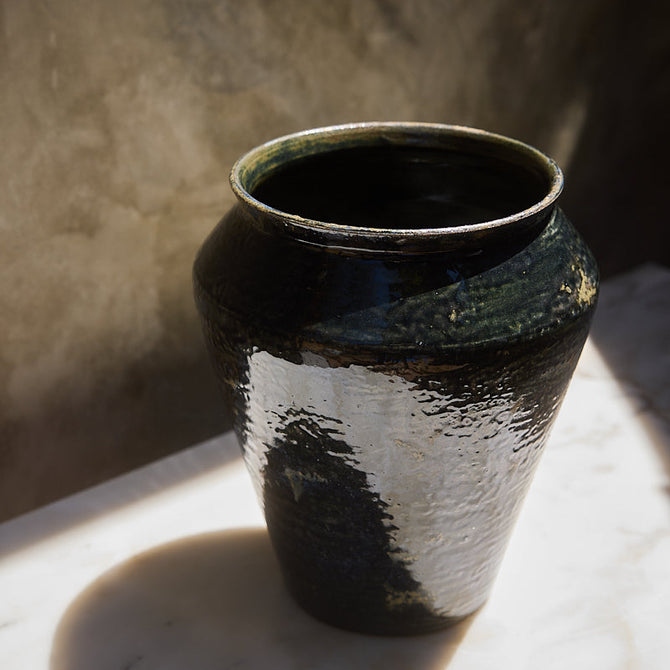
"The best and worst thing about pottery is its unpredictability. So I think the more you lean into that, the more you will enjoy it. Trying to replicate identical results really sucks the fun out of it for me, because honestly, the materials will rarely comply. With my photography and my pottery, I try to put a ghost in the machine. I like an uncontrollable quality in the mix that forces my hand. Bonfire ash does that for me. I take a beautiful memory of evening fires on the lake in Ontario, and then depending on which trees were burned, how many, what remnants are left in the ash, which glaze it's playing with, and how much I use, I will get wildly different results. I love that somehow through the fire it creates this lake effect. The glaze came out literally looking like the summer lake, and how can you not be thrilled with that."

Katherine Holland / Toronto
Summer Bonfire Vessel No.3
Bonfire ash glaze from Ontario lakeside fires. Wildly different results each time depending on the wood, the glaze, and the kiln. The lake effect in clay.
$190 CADShop Now →
Patchwork is another recurring idea in your work. What draws you to that aesthetic, the pieced-together, the assembled?
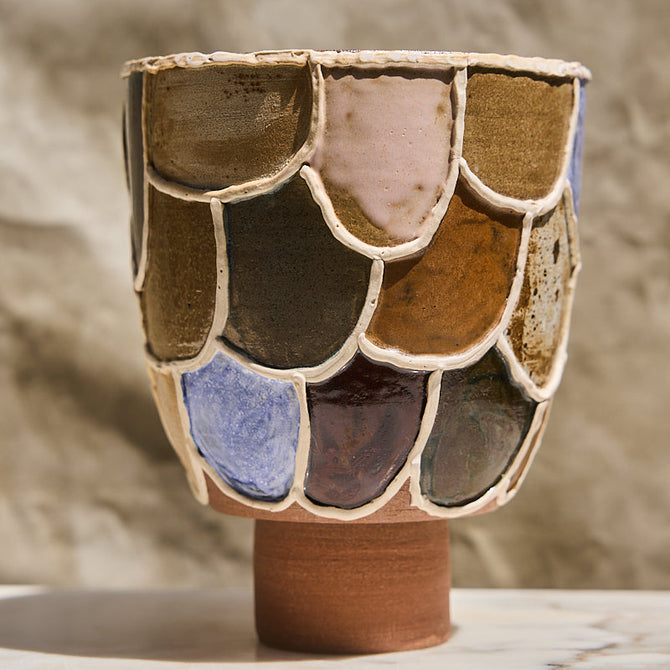
"I think that is all just me trying to incorporate play whenever I can. I want the work to feel intentional but also playful. I like that it showcases the glazes I've built side by side, like a retrospective, but it also gives this farmhouse quilt quality that is comforting to me. They are also crazy difficult to make, so when they come out right, they are really satisfying. Reworking the same things to live together differently through a new process."

Katherine Holland / Toronto
The Patchwork Pedestal No.2
Assembled from fragments of Katherine's own glaze experiments. A farmhouse quilt in ceramic. Unrepeatable by definition.
$690 CADShop Now →
How much of what ends up in a finished piece was planned, and how much arrived during making?
"Surprisingly I'd say it's about 50/50. But that's the result of a lot of trial and error, throwing out a lot of pieces, and then deciding later the mistake was the part I grew to love about it. Typically the form is quite planned. And sometimes the clay cooperates more than others, but my core pieces start from a plan. I would say the best work comes from trying to remove my critical eye and accepting that I can create something new from it. Sometimes the clay wants to be something else that day, and the more you lean into that, the happier you will usually be with it. It is a very challenging push and pull, and you can be really hard on yourself when you are in the fight. But when you let go a bit, and let the ghost in, the end result will be better than what you had planned."
Where in the process do you feel most in control, and where do you let go?
"I have to admit, I absolutely loathe the drying process. Ceramics, especially at large scale like mine, have to dry evenly, and slowly, and I really, truly hate that. I just want to build it and put it in the fire and go nuts. But you will ruin every piece you make through warping if you don't respect the process. Throwing is a wonderful luxury, especially when you are in a good flow state. My rule with throwing is if you catch it on a good day, you have to throw until you literally can't throw any more. Because those magic days are a treasure and your hands can do no wrong there. Throwing is where you own the clay. Drying and glazing, it owns you."
On the handmade object
Each piece is one-of-a-kind. How do you think about the relationship between the person who made a piece and the person who lives with it afterward?
"I find it really wild that you can spend so much time on a piece and love it and feel proud of it, and then it goes and lives its life somewhere else and you don't even know who has it, how they are using it, or what they think about it. Part of that is weird, and makes you feel a bit exposed, and the other part of it is very healthy. I can't think too much about who is buying it, or it dictates what you make. A bit of a dangerous game. All I can do is hope they connect with it in a way that brings them some comfort, excitement, or beauty."
When you look at a finished piece, what tells you it's yours?
"For me, it's the interaction of the texture with the shape. There's also a level of completion I look for, that I find a bit hard to articulate. I know it in a photo when it feels done, and I know it in a ceramic piece. It is sort of a roundness, and an interaction, like your eye goes around in a circle and then comes back again. It doesn't get stuck. For me, when your eye gets stuck somewhere, it's a failure."
What is the difference, to you, between a ceramic piece that is decorative and one that is functional? Do you draw that line, or does it blur?
"I think it's okay for there to be a blur there. Of course you have to keep in mind the limitations of certain glazes in terms of their interaction with food or anything that stains. But ultimately for me, the artfulness needs to be prioritized. There are enough pieces out there that you can throw in your dishwasher. I'm okay with mine not really being that. Mine are about celebration."
The collection and what's next
You design a lot of your pieces to work across contexts. Is that dual-function quality something you're building in from the start, or does it emerge from the form?
"I like to encourage people to find a place for art and celebration in their lives. It's a difficult thing to prioritize sometimes, and I think when there are multiple ways to use something, it's able to meet you where you are at that moment. Don't have the time or desire to put in a floral frog, or some flowers? That's a bowl for oranges now. It's gotta be useful and happy for you. I have been really inspired by florists and bakers over the years, and a healthy dose of sugar and flowers will punch up your life, so they are often the supporting characters in my work."

Katherine Holland / Toronto
The Feast Bowl No.4
A bowl built to hold fruit, flowers, or nothing at all. Dual use was the intention. Art and celebration, meeting you where you are.
$410 CADShop Now →
What's a piece or a direction you haven't explored yet that you're thinking about?
"I really want to get into framed wall hangings. I have found it hard to prioritize, because hand building doesn't come very naturally to me, so I'm trying to mix a few of my processes in a new way. But I like the idea that you can introduce more ceramic art in your life without being limited by your shelf or counter space. And the idea of framing it alongside my photo work seems like a seamless transition for me. Also, I'm obsessed with children and seniors, and want to make something just for them, because they deserve it."
When someone comes into Mararamiro and picks up one of your pieces for the first time, what do you hope they feel?
"I hope they feel the love and interaction with nature that I try to put into every piece, that they love running their finger around one particular spot on it, and that it gives them that little tickle in the back of their head."
Frequently asked questions
Who is Katherine Holland?
Katherine Holland is a Toronto-based photographer and ceramicist. She began making ceramics six years ago, and her practice has since grown into a full collection spanning mugs, vessels, bowls, pedestals, and sculptural pieces. Her work is known for its textural surfaces, bonfire ash glazes, and one-of-a-kind patchwork forms. It is carried at Mararamiro and featured in the September 2026 issue of House & Home.
What is the Summer Bonfire series?
The Summer Bonfire series uses actual bonfire ash from evening fires on Ontario lakes as part of the glaze. The ash interacts with Katherine's glazes differently depending on which trees were burned, the quantity of ash, and the firing conditions, producing results that cannot be predicted or replicated. The resulting surfaces read like summer lake water, which is where the name comes from.
What is the Patchwork Pedestal?
The Patchwork Pedestal is assembled from fragments of Katherine Holland's own glaze experiments: tests cut apart and joined into a single object. Each pedestal is genuinely unrepeatable, not because Katherine chooses not to remake it, but because the specific glaze fragments that produced it no longer exist in that combination. It is both handmade and one-of-a-kind in the strictest sense.
Are Katherine Holland ceramics food safe?
Some pieces are food safe and some are not, depending on the glaze. Katherine keeps food safety in mind when designing pieces intended to hold food, but she notes that artfulness is her primary concern. She is candid about this: her pieces are made for celebration, not necessarily for the dishwasher. Check individual product pages for details, or ask in store.
Where can I see Katherine Holland ceramics in person?
Katherine Holland's collection is at Mararamiro, 2090 Dundas Street West in Roncesvalles, Toronto, open Wednesday through Sunday. The full selection is also available online at mararamiro.com.
Shop Katherine Holland
Mugs, vessels, pedestals, and bowls. Every piece one of a kind. Made in Toronto.
Shop Katherine Holland →In-store at 2090 Dundas Street West, Toronto. Open Wednesday through Sunday.


