


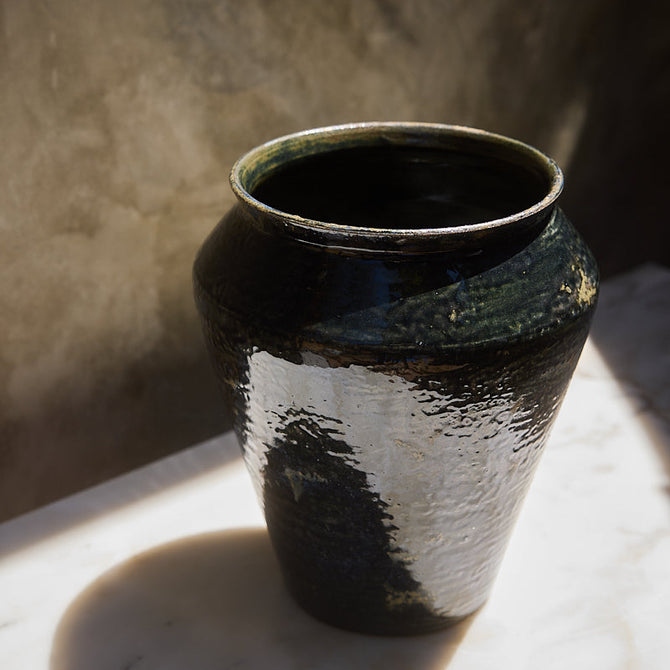

Handmade home goods cost more than their mass-produced counterparts. That is just true, and there is no point pretending otherwise. A hand-blown glass from a Paris studio, a ceramic pedestal assembled from a maker's own glaze experiments, a gourd basket woven by Ndebele artisans in Bulawayo, a bronze door pull cast and finished by hand in Toronto, none of these are priced like something stamped out on a factory line. What is not always obvious is what that price difference actually represents, and whether it is worth it. The short answer: usually yes, and for reasons that go well beyond the object itself.
In this article
- What are you actually paying for?
- Does handmade mean better quality?
- Is there a cost-per-use argument for handmade goods?
- What about pieces that can only exist once?
- What does buying handmade actually support?
- How do you know if a piece is fairly priced?
- Frequently asked questions
What are you actually paying for?
When you buy a mass-produced item, the price reflects materials plus the efficiency of a machine that runs around the clock and never needs to stop for a second look. When you buy something handmade, the price reflects something different: a person's time, skill, and judgment applied to every single piece.
Consider glassware. A factory line produces hundreds of identical tumblers per hour. Sébastien Nobile, co-founder of La Soufflerie in Paris, might produce a dozen in a day, each one shaped by breath and hand, each one varying slightly in weight, texture, and the way it catches light. When he and his wife Valentina started the studio in 2009, fewer than five professional glassblowers remained in the Paris region. The price of a La Soufflerie piece reflects that context: years of skill, a dwindling craft, and materials sourced and melted by hand.
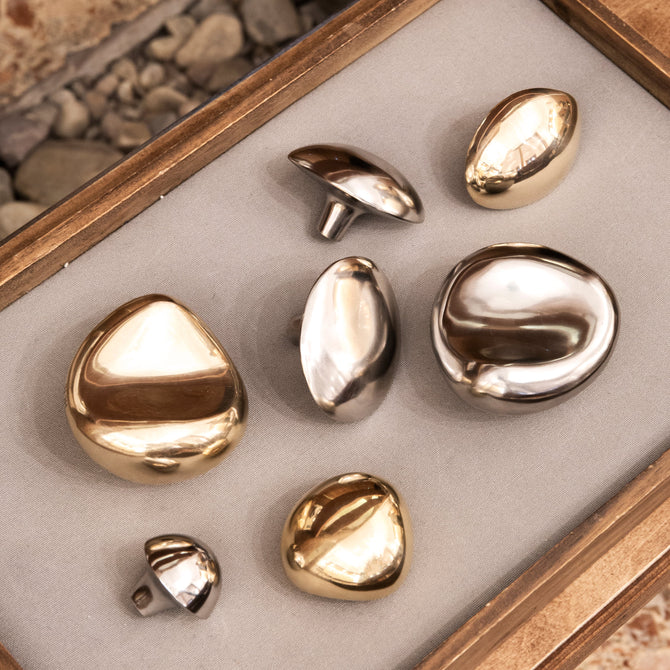
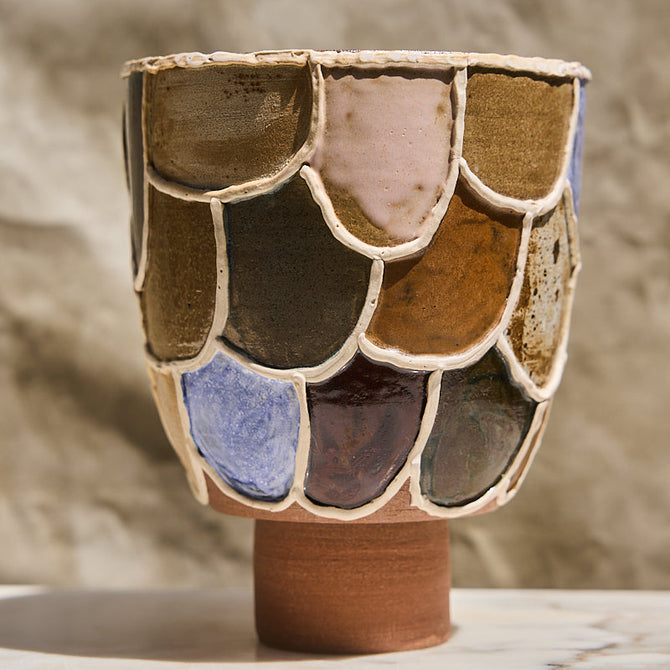
The same logic runs across every category on this list. The Patchwork Pedestal below is assembled from fragments of Katherine Holland's own glaze tests. The Bulawayo Gourd Basket is hand-woven by Ndebele artisans using techniques passed through generations. The CERCLE hardware by Maha Alavi is cast and hand-finished in Toronto, each piece bearing the subtle variation that comes from human hands rather than a mold running at volume.
The components that drive the price of handmade goods are consistent across materials:
- Labour time. A skilled artisan invests hours, sometimes days, in a single piece. That time is built into the price, as it should be.
- Materials. Small-batch makers source higher-quality inputs than mass manufacturers, because they are not buying in quantities that unlock the cheapest tier.
- Skill acquisition. The expertise behind a well-made piece took years to develop. You are, in part, paying for that knowledge.
- Limited production. Handmade goods cannot benefit from economies of scale. Each unit carries a greater share of the overhead.


La Soufflerie | Paris
Rock Glass - Framboise
Stone-like contours in a deep raspberry tone that shifts with the light. Made from recycled glass, no two sit quite the same.
$45 CADShop Now →

Ndebele Artisans | Bulawayo
Bulawayo Gourd Basket
Hand-woven by Ndebele artisans in Bulawayo. The organic gourd shape is built stitch by stitch, no two the same.
From $165 CADShop Now →
Does handmade mean better quality?
Not automatically. There are skilled makers and less skilled ones, just as there are well-made factory goods and poorly made ones. But the conditions that produce handmade goods are structurally tilted toward quality in a way that mass production is not.
A maker who puts their name to a piece has a direct reputational stake in every object that leaves their hands. They are not one anonymous quality-control step in a chain of dozens. They made it, they are selling it, and they will hear about it directly if something is wrong. That accountability tends to produce care.
Mass production is optimized for consistency at scale, not for the highest possible standard of any given unit. When the goal is producing ten thousand identical pieces as cheaply as possible, the material choices and finishing decisions reflect that goal. The result is often durable enough, but rarely exceptional.
With handmade goods, quality materials are not optional. A glassblower working with substandard glass cannot hide it. A basket woven with poor fibre will show it in the weave. A hardware piece cast from inferior alloy will feel it in the hand. Makers self-select toward better inputs, and that compounds the quality advantage at every stage.


Maha Alavi | Toronto
CERCLE Knob Small
A sphere reduced to its essentials. Cast and hand-finished in bronze or brass, the quietest upgrade a drawer or cabinet can get.
From $65 CADShop Now →

Maha Alavi | Toronto
CERCLE Pull Thin
A partial semicircle in bronze or brass. Balanced and precise, hardware that earns a second look. Available in multiple finishes and centre-to-centre sizes.
From $118 CADShop Now →
Is there a cost-per-use argument for handmade goods?
Yes, and it is one of the more underappreciated parts of the conversation.
Four Rock Glasses come to $180 in total. A comparable set of mass-produced tumblers might run $35 to $40, and last three or four years before clouding, chipping, or simply feeling disposable enough to replace. The La Soufflerie glasses, properly cared for, will likely be on your table fifteen years from now, still looking exactly right. The per-use cost of the more expensive set is lower over time, and you have not sent cheap glass to landfill in the interim.
The same logic applies to hardware. A set of CERCLE knobs fitted to kitchen cabinets will outlast the cabinets themselves. A set of builder-grade pulls from a home centre will not. And every time you open a drawer, you will feel the difference, or not notice it at all, which is the more honest version of what cheap hardware does to a space.
What about pieces that can only exist once?
Most handmade goods are made in limited runs, small batches, perhaps a few dozen of a given form. But some pieces sit outside even that logic: they are genuinely unrepeatable, not because the maker chose not to produce more, but because the specific conditions that produced them are already gone.
The Patchwork Pedestal by Katherine Holland is assembled from fragments of her own studio glaze tests, rejected experiments cut apart and rejoined into a single object. It is handmade in the fullest sense: labour-intensive, skill-dependent, and made from quality materials. But the premium you are paying over a production ceramic is not about those hours at the bench. It is about the unrepeatability. The specific glaze fragments that produced this piece will never exist again in that combination. When it sells, that particular thing is gone.
This is a distinct pricing logic from standard handmade, though the two often overlap. Vintage objects, where the price reflects age, provenance, and survival rather than anyone's recent labour, operate on a third logic still, one that deserves its own treatment. (We will cover vintage pricing separately.)


Katherine Holland | One of a Kind
The Patchwork Pedestal No.1
Assembled from fragments of Katherine's own glaze experiments. A record of the studio process, made into a single unrepeatable object.
$690 CADShop Now →

Katherine Holland | One of a Kind
The Patchwork Pedestal No.2
The second in the series: same process, different glaze fragments. No two pedestals read the same way.
$690 CADShop Now →
What does buying handmade actually support?
When you buy handmade, the money goes directly to the person who made the thing, or to a small retailer who sourced it from them. It does not pass through a corporate supply chain that extracts margin at every step and pays the least it can to the people doing the actual work.
It also supports the continuation of a craft. La Soufflerie exists specifically because Sébastien Nobile decided in 2009 to do something about a technique that was nearly extinct in Paris, loading four hand-blown vases onto a bike and riding around to flower shops until they sold. The Ndebele basket-weaving tradition in Bulawayo survives in part because there is a market for the work. Katherine Holland's glaze research continues because her one-of-a-kind pieces find buyers who value the process, not just the object.
At Mararamiro, every piece we carry is sourced from makers whose process we understand. We know how it was made, by whom, and why the price is what it is. That context matters to us, and we think it matters to the people buying from us too.

La Soufflerie | Paris
Alien Glass
A compact sculptural drinking glass with applied side forms. Everyday function with a shape no machine would arrive at.
$55 CADShop Now →
How do you know if a piece is fairly priced?
A few questions worth asking before you buy:
- Can the seller tell you who made it? A vague "artisan-crafted" label is not the same as a named maker with a traceable process.
- What are the materials? Quality materials cost more. If a piece is priced as handmade but uses the same inputs as mass production, ask why.
- Does the price reflect the labour involved? A piece that took six hours to make, priced at $40, is either made by someone not paying themselves fairly or is not what it claims to be.
- Does the variation make sense? Genuine handmade pieces will have slight differences between units. If every piece is perfectly identical, it was probably not made by hand.
Makers who are transparent about their process tend to price fairly. La Soufflerie notes on every product that air bubbles, pontil marks, and irregularities are attributes of the process, not defects. Katherine Holland lists the glaze fragments by studio batch. Maha Alavi specifies finish and dimension variants precisely because those details matter to the finished piece. That kind of specificity is a reliable signal, and the same standard applies to everything we carry.
Frequently asked questions
Why is handmade more expensive than mass-produced?
Handmade goods require skilled human labour on every single piece, higher-quality materials than mass production typically uses, and small-batch production that cannot benefit from economies of scale. Each of these factors adds cost. The price reflects what the object actually cost to make, including a fair wage for the person who made it.
Is handmade home decor actually better quality?
Generally, yes, though it depends on the maker. The conditions that produce handmade goods, a named artisan with a direct reputational stake in each piece, better materials, slower and more attentive production, tend to produce higher quality outcomes than factory manufacturing optimized for cost and volume. Sourcing from a retailer who vets makers directly helps.
Is it worth spending more on handmade glassware?
Over time, usually. Four Rock Glasses at $180 total will likely be on your table fifteen years from now. A $40 factory set probably will not make it five. The per-use cost of the handmade set is lower across its lifetime, and the experience of using them every day is not comparable.
Why are one-of-a-kind pieces priced so differently from regular handmade?
Standard handmade pricing reflects labour, skill, and materials. One-of-a-kind pricing adds a third factor: the specific conditions that produced the piece no longer exist, so it genuinely cannot be made again. The Patchwork Pedestal is both handmade and unrepeatable, but it is the unrepeatability you are paying the premium for. That distinction matters when you are deciding whether the price is fair.
Is handmade hardware worth the price compared to standard cabinet hardware?
Yes, particularly for pieces you interact with daily. Hand-finished hardware like the CERCLE line is cast from quality alloys, finished by hand, and built to outlast the furniture it is fitted to. The difference is most obvious in feel, weight, finish, the way a knob sits in the hand, and it compounds every time you open a drawer.
Where can I buy handmade home goods in Toronto?
Mararamiro carries a curated selection of handmade and one-of-a-kind pieces at 2090 Dundas Street West in Roncesvalles, and online at mararamiro.com. Open Wednesday through Sunday.
Shop Handmade at Mararamiro
Glassware, ceramics, baskets, hardware. Every piece sourced from makers we know, in Roncesvalles and online.
Shop the Collection →In-store at 2090 Dundas Street West, Toronto. Open Wednesday through Sunday.


