


A sumac wax candle from Daiyo is built the way a tree grows: one thin layer at a time, by hand, around a wick of paper and rush. The wax is pressed from the fruit of the haze tree, not refined from oil, and the result is a candle with a tall, slow-moving flame, very little smoke and no wax running down its sides. The workshop that makes them has been doing it in Takashima, on the shore of Lake Biwa, since 1914.
This is the candle we hand people when they ask for something for the table that will actually be lit. Here is who makes it, how, and how to live with it.
In this article
- Who makes them
- What sumac wax is
- How a candle is built by hand
- Why the flame looks different
- Living with them
- Which size to choose
- Frequently asked questions

Who makes them
Daiyo (大與) is a family candle workshop in Imazu, a lakeside town in Takashima, Shiga Prefecture. Yoichiro Onishi founded it in 1914 after training at a candle shop in Osaka and coming home to start his own. The business is now in its fourth generation. Takumi Ohnishi has led it since 2011.
The workshop makes warosoku, the traditional Japanese candle. Daiyo turns out around 800 hand-made candles a day, and in summer the day starts at five in the morning, while it is still cool enough to work the wax. They say it takes about ten years to become a seasoned candle maker there.
What sumac wax is
Most candles are paraffin, a by-product of petroleum. Sumac wax is a plant wax pressed from the fruit of the haze tree, a Japanese relative of sumac. Daiyo uses it without additives. The same workshop also makes candles from rice bran wax, a by-product of milling rice, which we carry as their Morphe Candles.
The wick is the other half of the story. Instead of braided cotton, a warosoku wick is made from washi paper and igusa, the rush used to weave tatami mats. It is thick, and it is hollow at the centre, and that shapes the way the candle burns.
How a candle is built by hand
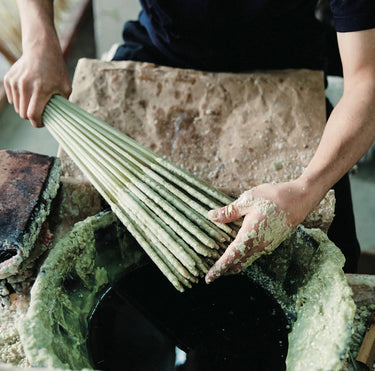
Daiyo's method is called tegake, which means "hand-applied." The wicks are set on skewers and dipped three or four times in raw wax, with each coat left to dry. Then the maker works warm wax onto the candles by hand, layer after layer, letting each one set before the next, until the candle reaches its full thickness.
Cut one in half and you would see the layers as rings, the way you see the years in a tree. Daiyo points out that the room's temperature, the weather and the maker's own state of mind all show up in the wax, which is why the work starts early and why no two batches are quite the same.

Why the flame looks different
Light one and the first thing you notice is the size of the flame. The thick paper and rush wick carries more fuel than a cotton wick, so the flame stands tall and bright, and because the wick is hollow, air is drawn up through its centre. The flame breathes and shifts slowly even in a still room. It is a livelier light than people expect from a candle this slim.
The second thing is what does not happen. Sumac wax burns with very little smoke, and it does not run down the sides of the candle onto the table. That is why these work so well at dinner: you can set them close to food and linen and forget about them.
Warosoku have been burned in Japan for many centuries, first in temples, then in homes. They were made to be looked at, and they still are.
Living with them
Three things are worth knowing.
- Use a spike, not a socket. A warosoku has a hole through its base and sits on a pin. A spiked holder keeps it upright and lets the candle burn all the way down. Ours include the Koma Candle Stand in cast iron, the Rippōh Candle Spike in ceramic and iron, and the Brass Candle Spike.
- Trim the wick as it burns. The thick wick turns to charcoal at the tip. When the flame starts to grow dark or uneven, trim the spent tip and it brightens again. This is part of the ritual, not a fault.
- Never leave it alone. Like any open flame, keep it away from drafts, children and pets, and let the holder cool before you move it.

Daiyo / Japan
Brass-Tip Wick Trimmer
Made for the warosoku wick. A brass weight in the handle tips the points up when it rests, so ash never touches the table.
$165 CAD
Shop now
Which size to choose
We carry Daiyo's sumac wax candles in three lengths. All three are $32 a box.
- 10 cm, box of 6. About 30 minutes each. For a short ritual: a bath, a cup of tea, the end of the day.
- 13 cm, box of 4. About 70 minutes each. The length of a dinner. This is the one we suggest as a host gift.
- 15 cm, box of 4. About 105 minutes each. For a long table and a slow evening.

Daiyo / Takashima, Japan
Sumac Wax Candles, 13 cm
A box of four, built by hand around a paper and rush wick. About 70 minutes each.
$32 CAD
Shop now
Frequently asked questions
What is a warosoku?
A traditional Japanese candle made from plant wax around a thick wick of washi paper and rush. It sits on a spike rather than in a socket, and it burns with a tall, moving flame.
What is sumac wax?
A natural wax pressed from the fruit of the haze tree, a Japanese relative of sumac. It is plant-based rather than petroleum-based, and Daiyo uses it without additives.
Do sumac wax candles smoke or drip?
Very little smoke, and they do not run down the sides. If the flame darkens or starts to smoke, the wick needs trimming.
Are they scented?
No. The wax has only a faint, natural smell, which is why they work on a dinner table.
Do I need a special holder?
You need one with a spike. A standard candlestick socket will not hold a warosoku securely.
Are they a good gift?
For almost anyone. A box gets used, it has a real maker and a long tradition behind it, and it takes up no shelf space once it is gone. For more ideas, see how to choose a gift for someone you barely know.
Find it in the shop
The candles, spikes and wick trimmer are all at 2090 Dundas Street West in Roncesvalles, and online in Evenings In. Come by and see them in person.