




Santiago spent eight years as an architect before he put down the laptop and picked up a plane. In 2025 he left practice to start Grain & Grid, a furniture studio in Toronto built on solid hardwoods and curves that refuse to settle for a right angle. We carry three of his pieces: The Architect Chair, The Library Table, and The Duo-Function. We asked him about the leap, the process, and what he wants someone to notice the first time they bring one of his pieces home. His answers are below, in his own words.
In this Q&A
- Origin and the leap
- The work and the process
- Design philosophy
- Toronto and the local context
- The collection and what's next
- Frequently asked questions

Origin and the leap
You spent eight years as an architect before leaving practice in 2025 to make furniture full-time. What finally made you go?
"Although architecture is a profession that seems very creative, the day-to-day work is very monotonous. I was tired of sitting in front of a computer screen all day and doing technical tasks. I couldn't see myself working in architecture for the rest of my life, so after discussing it with my wife, I decided to take the plunge and start Grain & Grid."
Architecture and furniture-making share a vocabulary, structure, proportion, material, but they are very different disciplines. What surprised you most about working at this scale?
"In architecture, because the scale is so large, precision is lower than in furniture making. In furniture design, every millimeter counts. In furniture, if a joint is off by a fraction of a millimeter, the piece fails aesthetically and structurally. Designing at a 1:1 scale means you can't hide behind a drawing."
Was there a specific piece, project, or moment where you thought: this is what I should be doing?
"Building 'The Architect Chair' was a definitive moment. I realized I didn't want to go back to architecture. It was through that project that I learned about different joints, how wood grain works, and the process and value of creating a custom chair."
The work and the process
You handle every stage yourself, from selecting the lumber, shaping, sanding, to finishing. Where does a piece actually begin for you?
"It all starts with my sketchbook and a Pinterest board. Then I move to my computer, where I create a 3D model of the final design, adjusting the scale and proportions and adapting each piece to make the most of the material. Next, I go to the lumberyard and select the rough lumber; then, in the workshop, I plane the wood slats, cut them, glue them, sand them, and apply the final finish to ensure the highest possible quality."
How do you select a piece of wood? What are you looking for, and what gets left behind?
"I choose the wood slats that are in the best condition, those with fewer knots, no cracks, and are clean, where the grain and texture are clearly visible and bring out their color."
"When I model everything in 3D, I create a file that allows me to make the most of the wood, and the small pieces left over from the cuts are set aside in a bin where the people in the workshop can use those scraps to make other things, such as small frames, cup holders, or even cutting boards."
Walnut and oak are your primary materials. Why those two, and do they each call for a different approach?
"All the woods I use are hardwoods, and the main difference between them lies in their strength. I use walnut, oak, and ash because I like their texture and color the most, and they all look elegant and stand out in any space. The difference is that walnut is less dense than the other two, so it's easier to cut and harder to burn, but they're essentially similar, and they're all high-quality woods that will last for many years."
Your training is in 3D modelling and spatial thinking. How much of the design work happens on screen versus in the shop?
"I'd say 30% on the screen and 70% in the workshop. On the screen is where I make sure everything is exact and that what I'm going to cut has the precise measurements, but the magic happens in the workshop, where the joints and ergonomics are solved. You still can't feel or sit on the 3D model."
What's the hardest part of a piece to get right, and why?
"I think the hardest part is figuring out the joints and how each piece fits together. If the pieces don't have any straight edges and are curved, you usually have to make templates to help you glue two pieces together. I think it's always important to build a prototype to understand its design strengths and weaknesses."

Grain & Grid / Toronto
The Library Table
Solid walnut, with an integrated canvas sling for books and magazines. Built end to end by Santiago. One piece. Freight shipping; local delivery is complimentary.
$1,495 CADShop Now →
Design philosophy
The Architect Chair has a very particular set of proportions. It's almost severe, but not cold. How do you hold that line between architectural precision and something you actually want to sit in?
"I believe the most important thing is to find the right balance between precision, beauty, and comfort. I aim to ensure that the chair's width, tension, leg height, and armrests are just right so that you can sit comfortably for hours. In particular, I start designing chairs with a side elevation showing the ideal seating angle; from there, I begin sketching lines and combining them with my drawings to find a balance between technical and structural considerations and aesthetic appeal."
"Intended to be used daily and kept for years" is a strong claim. What does a piece have to do, structurally and materially, to earn that?
"It has to be built using solid hardwoods and structurally sound joinery, no shortcuts. Combining the precision of the 3D model and CNC cutting, which cuts each piece exactly as shown on the computer, with manual techniques for rounding the edges, fitting tenons, and gluing each piece ensures that a piece crafted with the utmost care can last for years."
Is there a joint, a detail, or a construction technique you keep returning to, something that feels like a signature?
"I think my signature style is using curves, avoiding right angles, not settling for easy connections, and creating unique pieces that stand out because of their shape."
Toronto and the local context
You're making furniture in Toronto, sourcing North American hardwoods. How much does place matter to what you make?
"Canada and Toronto in particular is a place that has given us everything. The community spirit and kindness of this city's residents are unique; there's a big support for local products, and once you start building a life here, the locally made label really matters. That's why using local wood to support the local industry is very important to me."
Is there a local furniture-making or design community here? Who are you in conversation with?
"The community of local furniture makers is much larger than people realize. Over the past year, I've met some incredibly talented people. Two small furniture makers, Redline Design (MK) and Atelier Noyo (Quentin), also work in the workshop. Like me, they're trying to make a living from furniture, and each of us has something that makes us unique. At various design events, I've met furniture makers from Etobicoke and Mississauga, and the quality of their products is exceptionally high."
The collection and what's next
The Duo-Function is the most accessible piece in the collection at a $425 entry point. Was that intentional, or did it come from somewhere else?
"Making this stool or side table was a nice break from making products that require more time and materials to produce, and I wanted to create something relatively simple, something that would be easier to make but still bear my signature style but be more accessible to the public."

Grain & Grid / Toronto
The Duo-Function
Solid walnut, moving between stool and side table. The most accessible entry point into Santiago's work, built with the same signature curves. One piece.
$425 CADShop Now →
What's a piece you want to make that you haven't made yet?
"I haven't had the chance to design a dining table yet, and I'd love to because it's a much larger scale that presents different manufacturing challenges and it's the focal point of a space in the house like the dining room."
If someone is bringing a Grain & Grid piece into their home for the first time, what do you want them to notice first?
"I want them to feel like they're buying a high-quality piece, to feel the material, to see that the grain and finish are high end, to know they're taking home a one-of-a-kind piece, and to enjoy their purchase when they use it, which is exactly why I designed and crafted it."
Grain & Grid / Toronto
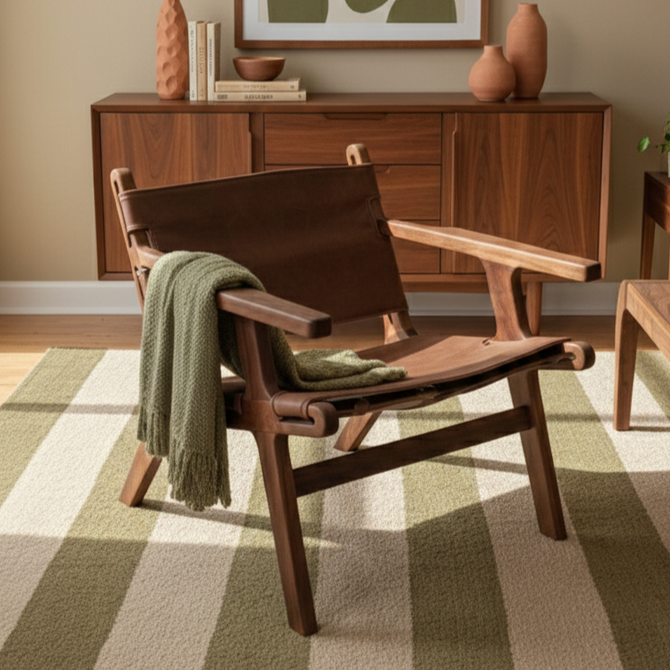
The Architect Chair
Solid walnut, sculptural frame, suspended seat and backrest. The piece that convinced Santiago to leave architecture for good. One piece, built start to finish in his workshop.
$2,995 CADShop Now →
Frequently asked questions
Who is Santiago from Grain & Grid?
Santiago is a Toronto-based furniture maker and former architect. He spent eight years practising architecture before leaving in 2025 to start Grain & Grid, a furniture studio working in solid North American hardwoods, primarily walnut, oak, and ash. He handles every stage of production himself, from 3D modelling through final finishing.
What materials does Grain & Grid use?
Solid hardwoods, primarily walnut, oak, and ash, selected for clean grain, minimal knots, and no cracks. Walnut is the most commonly used material across the current collection. All pieces are built using structurally sound joinery, combining CNC-cut precision with hand-finished joints and edges.
Is Grain & Grid furniture made to order or one of a kind?
Each piece is built individually by Santiago from start to finish in his Toronto workshop. The pieces we currently carry, The Architect Chair, The Library Table, and The Duo-Function, are each available as a single unit, while additional pieces are made to order.
How does Grain & Grid furniture ship?
Larger pieces such as The Library Table and The Architect Chair require freight shipping; contact hello@mararamiro.com for a quote. Local delivery in the Toronto area is complimentary.
Where can I see Grain & Grid furniture in person?
Mararamiro carries Santiago's current collection at 2090 Dundas Street West in Roncesvalles, Toronto, open Wednesday through Sunday. The full collection is also available online at mararamiro.com.
Shop Grain & Grid
Solid hardwoods. Built start to finish by Santiago in his Toronto workshop. One piece each.
Shop Furniture →In-store at 2090 Dundas Street West, Toronto. Open Wednesday through Sunday.


